

For Texas Employers - Less chasing & better co-ordination with MobilityZ Health
Injured workers get back to work sooner when their employer and their clinicians stay in touch. In Texas, keeping in touch is the hard part.
It's 8:15 on a Monday morning. The workers' comp coordinator at a Texas manufacturer has nine open claims and a list of 23 phone numbers. One clinic's voicemail is full. A therapist promises a callback after lunch. A fax arrives from a third office, describing a visit from eleven days ago: "Patient improving. Continue PT."
Meanwhile, one of those nine workers could probably handle light duty on the packing line today. Nobody at the company knows it yet. They'll find out at the next work status report, maybe next week.
That gap, between when a worker is ready and when the employer learns it, is where Texas employers quietly lose weeks of productive work. This article explains why it happens, what the research says about closing it, and how MobilityZ Health is built to close it.
A short chain with a weak first link
Getting an injured worker back to work sooner comes down to three links, and each one depends on the one before it.
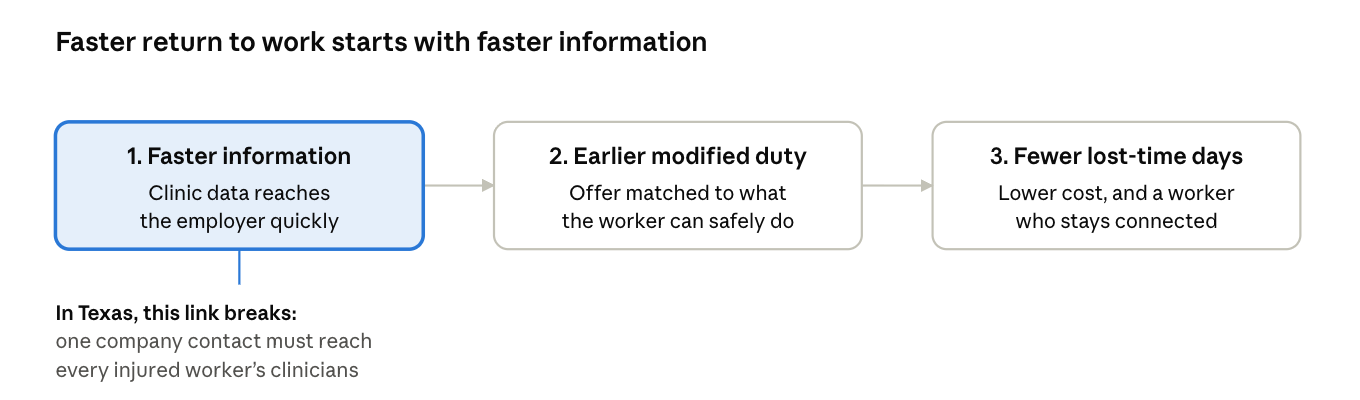
When clinical information reaches the employer quickly, the employer can offer modified duty matched to what the worker can safely do. Earlier modified duty means fewer lost-time days: lower cost for the company, and a worker who stays connected to the job instead of drifting away from it.
Research backs each link. The problem in Texas is the first one.
What the research shows
When clinics and workplaces share information, injured workers spend less time off work. Two bodies of research make the case.
Provider-to-workplace contact is one of the strongest levers. Canada's Institute for Work & Health reviewed workplace return-to-work programs for musculoskeletal and pain conditions. It found strong evidence that two things significantly shorten work disability: offers of work accommodation, and contact between the healthcare provider and the workplace. Early contact with the worker and a dedicated return-to-work coordinator also help (IWH, Franche et al.).
Coordinated care cut disability days in a real workers' comp system. Washington State's Centers of Occupational Health and Education (COHE) combined care coordination, provider best practices and patient tracking. A study of 105,607 claims measured the results (Wickizer et al., via CDC):
[embed: node/16b02747-4a39]
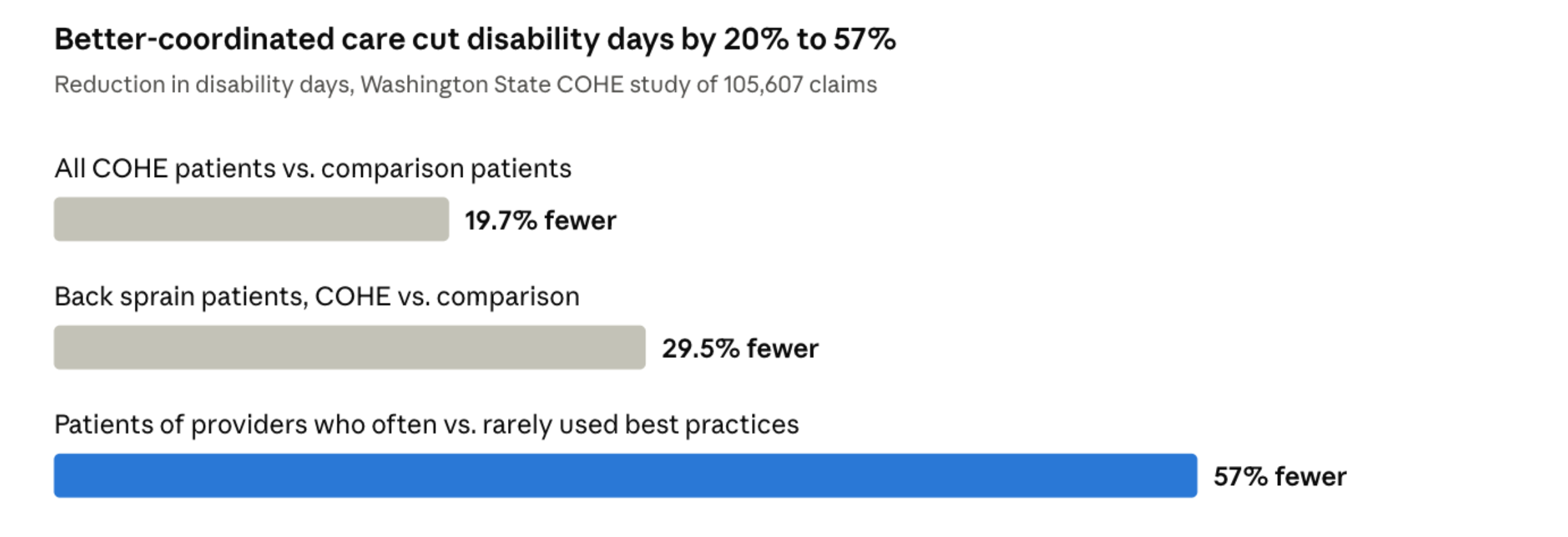
COHE patients also cost $510 less per claim in combined disability and medical costs. The biggest gain came where coordination was most consistent: the more often providers followed the practices, the fewer days their patients lost (PubMed).
Texas regulators point the same way. The Texas Division of Workers' Compensation notes that workers who return to productive work as soon as possible after injury need less medical care, have less disability, and earn wages instead of drawing weekly benefits (TDI).
The common thread is simple: reliable, timely information moving between the clinic and the workplace.
Why Texas breaks the first link
In Texas, one workers' comp contact at the company has to keep up with many separate clinicians, so the timely provider-to-workplace contact that research rewards rarely happens.
Each injured employee sees their own treating doctor, often within the carrier's network, plus physical therapists and sometimes specialists. No single clinic serves the whole workforce. Even a handful of open claims turns into a web of separate conversations:
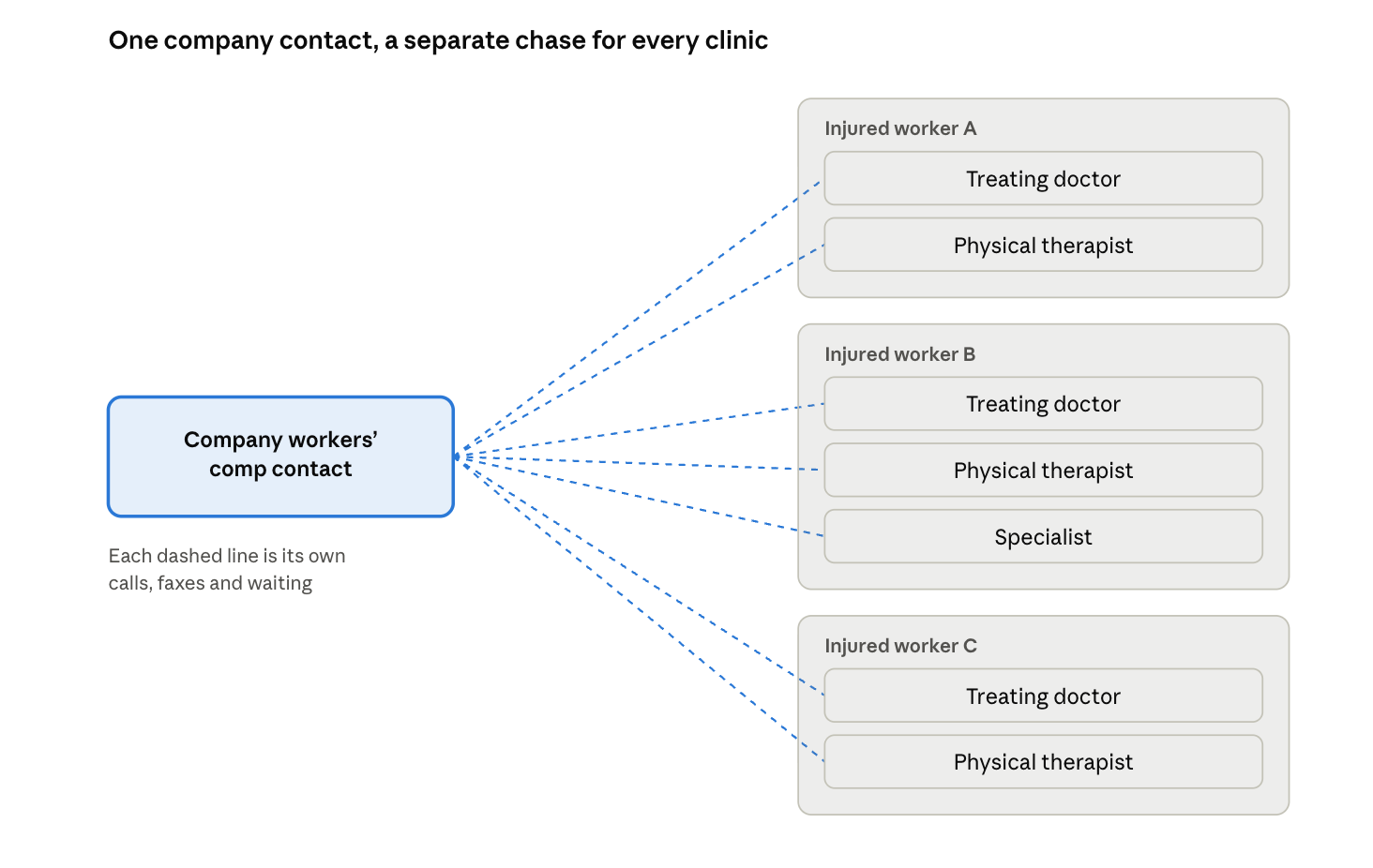
For every one of those lines, the coordinator:
calls a different office with its own hours and front desk;
waits for callbacks, faxes and visit notes on that clinic's schedule;
receives updates about the last visit, not about what the worker can do today;
learns a worker is ready for modified duty only after the next work status report.
The workload grows with every claim. At 15 open claims and two or three clinicians each, that's 30 to 45 separate relationships to keep current. At 30 claims, coordination becomes a full-time job, and updates fall weeks behind.
Every day between "the worker is ready for light duty" and "the employer knows it" is a lost-time day the employer pays for.
How MobilityZ fixes the first link
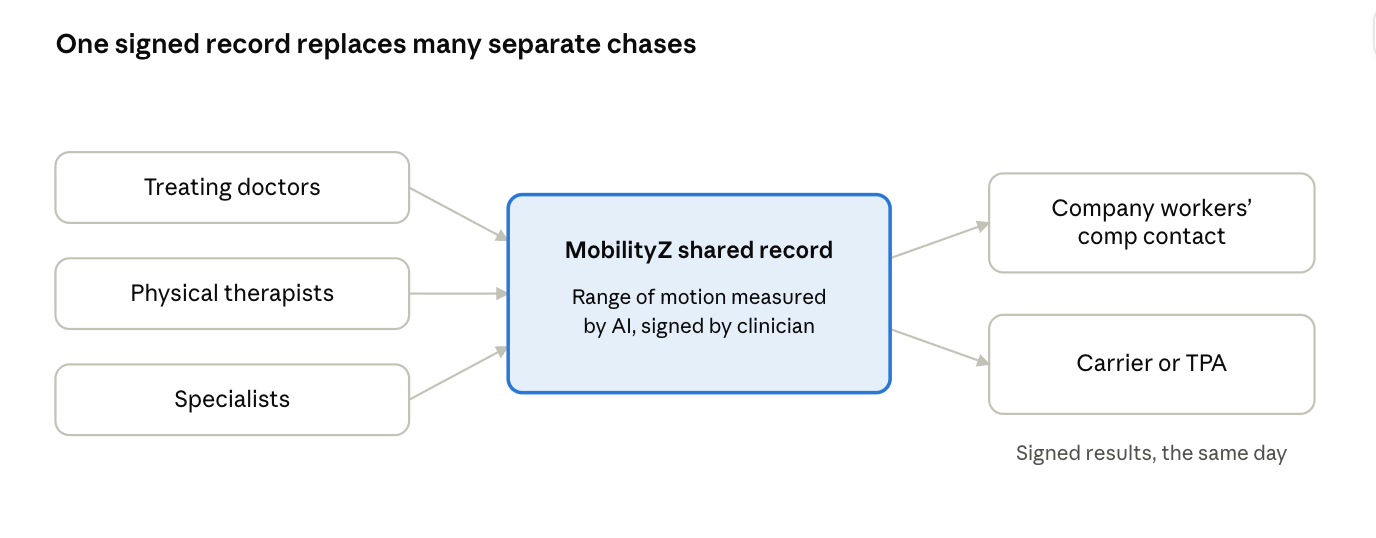
MobilityZ Health replaces dozens of one-to-one phone chases with a single shared recovery record, signed by the clinician and visible to the employer the same day.
What happens on a claim
Record. The treating clinician or therapist records a short guided video of the injured joint.
Measure and sign. MobilityZ AI measures the range of motion. The licensed clinician reviews and signs it, as Texas law requires for AI-assisted records, and the patient is told AI is part of their care.
Deliver. The signed result and the recovery trend reach the company's workers' comp contact and the carrier the same day.
Act. When measured motion meets what a modified-duty task needs, the employer flags it and the treating doctor confirms the restrictions.
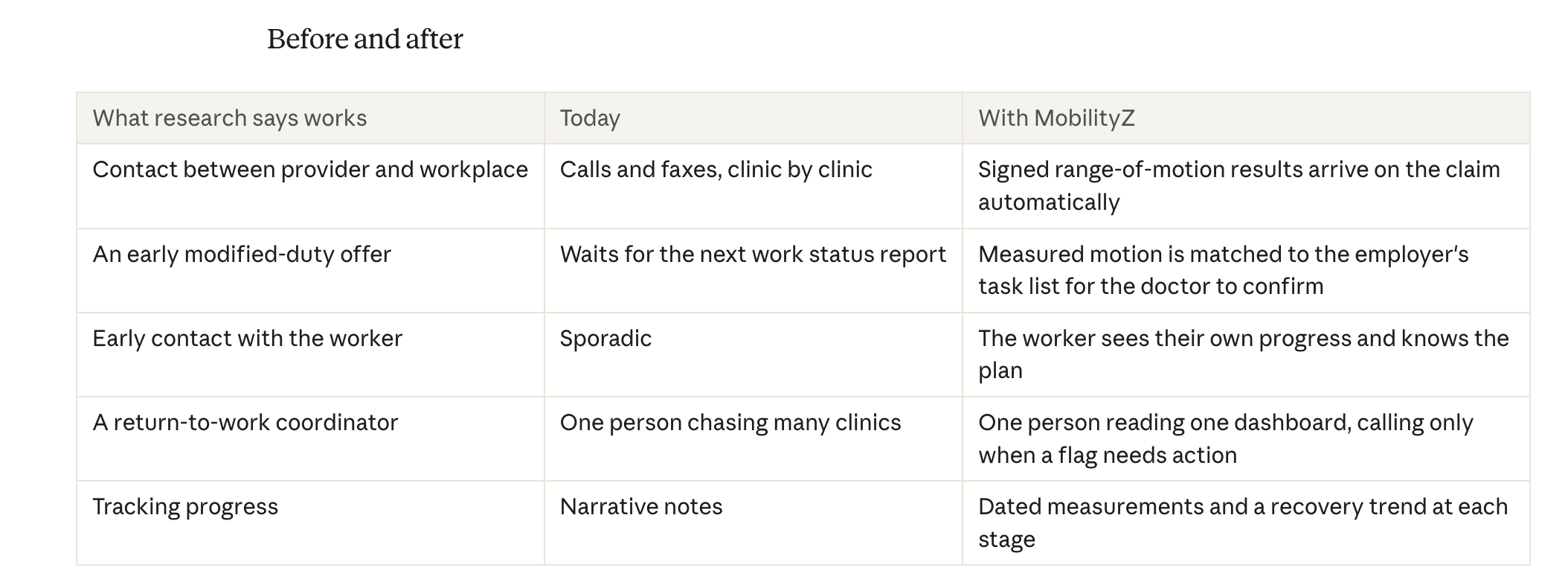
The clinician still makes every medical decision. What changes is that the employer learns the moment a decision can be made, not days or weeks later.
What Texas employers gain
The payoff is earlier, measured answers on every claim, and a pilot shows exactly how many lost-time days that saves.
Time back. The workers' comp contact reads updates instead of chasing them, and calls a clinic only with a specific question.
Fewer lost days. Modified duty can be offered as soon as the worker is able, not after the next report.
Lower cost. Fewer weekly income benefit payments and lower medical costs, the kind of results Washington's coordinated-care program achieved.
Stronger teams. Workers stay connected to the job and can see their own recovery progress.
A note on the numbers: the Washington and Institute for Work & Health findings show what better coordination can do. They are not MobilityZ results. A MobilityZ pilot measures the effect on your own Texas claims, against your own baseline.
Let's start working together
If your team spends its mornings chasing clinics, we'd like to inform how we can mitigate this together. Lets work together and pick a pilot site.
